

Enablement creates capability. Activation turns that capability into daily use. If training is done but usage is lagging, activation bridges the gap.
When a client comes to Cognician with a stalled Copilot rollout, the pattern is usually the same. Licenses are live. Training is complete. Expectations were high, but usage has plateaued.
People understand Copilot. They just aren't using it.
That isn't a training problem. It's an activation problem.
Enablement Prepares People to Use Copilot.
Activation Ensures They Actually do.
Enablement is the layer most organizations know well. It's the structured guidance that helps people understand and become capable of using Copilot: the webinars, the LMS modules, the playbooks, and the office hours. Done well, enablement closes the knowledge gap of awareness, skill, and confidence. Its end state is "users know how to use Copilot."
Activation picks up where enablement left off. It's a behavioral layer that turns Copilot licenses into daily usage through guided, workflow-based experiences. Its end state is different: "users use Copilot daily."
Both are important, but only activation directly impacts ROI and delivers measurable value from Copilot use.
Where the Two Approaches Diverge
Here's how enablement and activation compare on three questions that decide whether a rollout is successful beyond license deployment.
| Question | Enablement | Activation |
|
What it is, and what it does (primary aim, gap it closes, unit of change) |
|
|
|
How people learn (core mechanism, learning mode, cadence, reflection, social learning) |
|
|
|
How effectiveness is measured (measurement focus, time to impact, typical failure mode) |
|
|
Read down the two columns and a pattern emerges. Enablement is content-led and event-shaped. Activation is behavior-led and habit-shaped. Enablement asks, "What do people need to know?" Activation asks, "What do people need to do, today, in the work already in front of them?"
Why the Gap Exists, and Why Training Alone Can't Close It
Most organizations invest heavily in enablement and assume activation will follow. It rarely does. The instinct to front-load a launch with webinars, decks, and comms campaigns leaves a gap between understanding Copilot and integrating it into the flow of work. Once training ends and the communication fades, usage flattens.
Activation is engineered for exactly that moment. Instead of passive content, it creates guided experiences that prompt people to use Copilot on the tasks they are already doing: drafting an email, summarizing a meeting, researching an account, reviewing a pipeline. Each action is small, measurable, and immediately useful. A nudge arrives. A reflection is captured. An insight is shared with peers. A habit starts forming.
This is why activation-led rollouts produce outcomes that traditional training never could.
Consider these three examples from Cognician's recent client work.
A major energy company ran a Copilot activation program and saw a 475% increase in time saved using Copilot, turning a stalled deployment into visible daily adoption.
An Agent Activation program run with Microsoft delivered a 200% sustained increase in agent usage across the client’s activated group, compared with just 28% in a matched control group, after only two weeks and eight daily challenges.
Most recently, a 450‑person pilot built the confidence to scale AI adoption to 10,000+ participants. Among those involved, everyday AI use reportedly rose from 54% to 76%, with thousands of shared insights helping turn early momentum into lasting habits.
These are outcomes no LMS completion rate could ever predict, let alone produce.
Can You Skip Enablement and Go Straight to Activation?
It’s a fair question, and one we hear often from leaders under pressure to show ROI quickly.
Short answer: sometimes, but only if activation is designed to carry the learning directly into the work itself.
Activation changes the sequence. Instead of asking people to learn first and apply later, it embeds learning inside real work. Participants are prompted to take small, guided actions on tasks they are already doing. The learning happens in context, at the moment of need, and is reinforced through reflection and peer proof.
In those cases, activation can substitute for large portions of traditional enablement, because capability is built through doing, not attending. What matters isn’t whether enablement is formally "skipped," but whether the rollout creates repeated, supported action early enough for habits to form.
That's why the highest performing Copilot programs don’t ask "Did we train people?" They ask, "Did people use Copilot on real work this week, and will they do it again next week?" Activation will answer yes to that question.
How to Tell Which One Your Organization Needs
Most enterprise Copilot programs need both enablement and activation, but in different proportions than most leaders assume. A few sense checks can help clarify where the real gap is:
-
Licenses deployed, but daily active usage remains flat? That's an activation problem, not a training one.
-
Can teams tell you what Copilot does, but not when they last used it on their own work? Enablement has landed. Activation hasn't.
-
Is measurement built on completion rates and survey snapshots? You can see readiness, but you can't see behavior, which means you can't see value.
-
Are champions doing most of the heavy lifting on social learning? That's a sign activation mechanics aren't built into the experience itself.
If any of those ring true, the fix isn't more content. It's a different layer on top of the content already in place.
The Missing Layer between Enablement and Value Realization
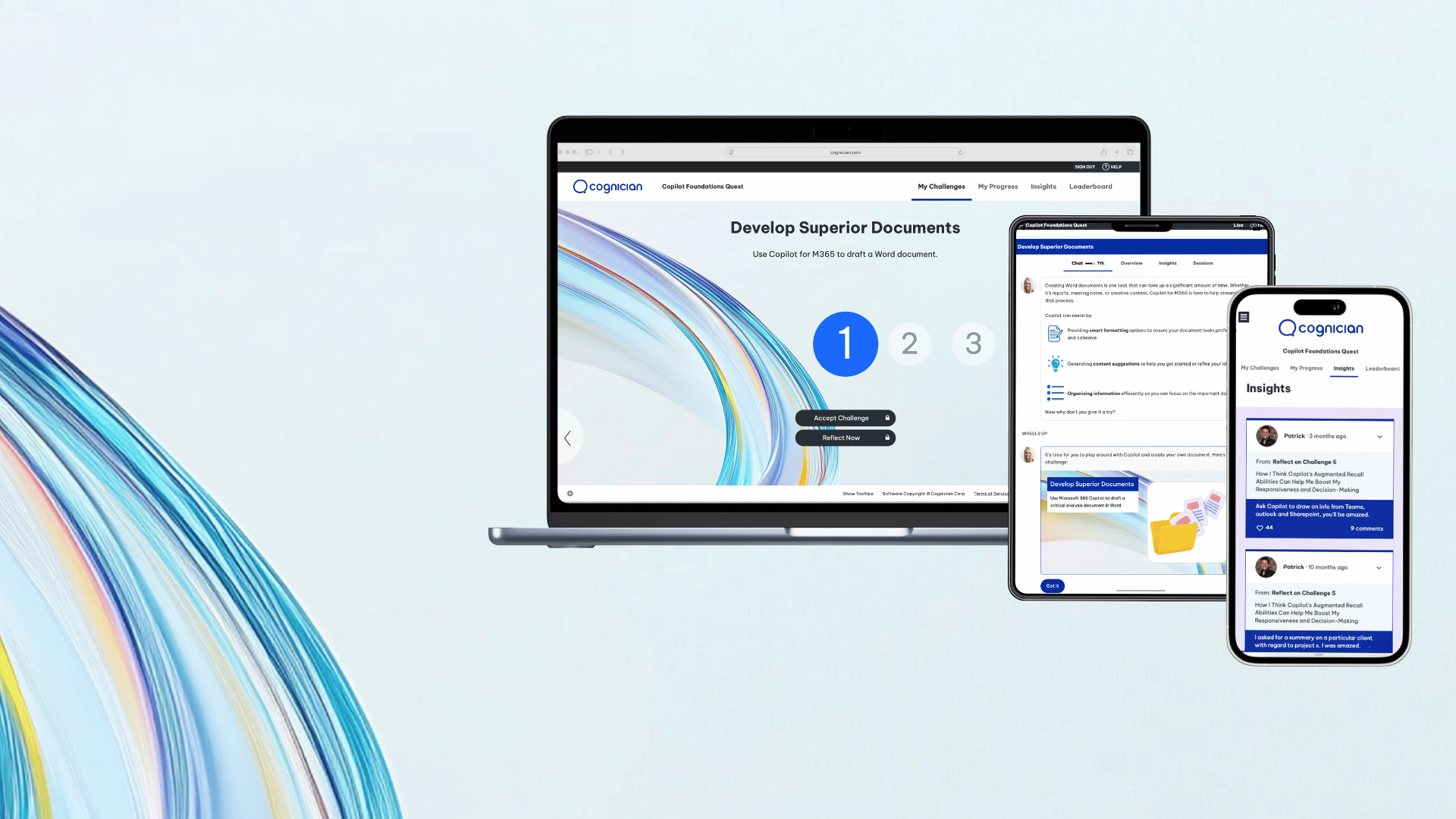
Cognician is purpose-built for that missing layer. It isn't an LMS, and it isn't a comms campaign. It's a behavioral activation platform that integrates into the enterprise ecosystem and converts capability into repeated, on-the-job usage. Guided quests. Embedded nudges. Built-in reflection. Peer-driven insights. Live behavioral data so leaders can watch adoption unfold and intervene where it matters.
Enablement makes Copilot understandable and usable. Activation makes Copilot used: daily, in the work that actually happens, and measurably.
If a rollout is sitting somewhere in between, the team at Cognician would love to help close the gap. Explore Cognician's Microsoft 365 Copilot adoption programs, or reach out to start a conversation.
Turn your Copilot investment into lasting results.

.png)
.svg)